I've got another classroom book to share. Last year I made a similar book about the concept of time with watches we made. Check it out here. I wasn't in the mood for watches this year and didn't really have time anyway. Instead each child held my big yellow clock. By the way, each of their times was different and matched Common Core standards for first grade. Enjoy!
Showing posts with label time. Show all posts
Wednesday, April 2, 2014
Saturday, March 8, 2014
Saturday Sayings: Beat Me to the Punch
I love this NCTM quote from Larry Buschman's book Share and Compare. I saw it play out more than once this week while working on the concept of time. (If you need some quality clock lessons grounded in understanding instead of memorization, go here.)
I've still got much to learn about questioning kids and ensuring they are doing most of the talking, but my goal is to purposefully orchestrate discussions so the children are discovering and not simply receiving information from my great wealth of knowledge. In one instance, we were investigating a numberless clock with only a minute hand. As I moved the minute hand to a numberless spot on the clock, we would figure out how many minutes it was past the hour. Of course, I didn't tell them there was an efficient way of counting the minutes. I knew someone would figure it out. Not surprisingly, Walter chimed in and explained the way he thought we should count them, by 5s of course. We dubbed it, "Walter's strategy" and I consistently referred to it throughout the remainder of the lesson. As we were transitioning to another part of the room for additional practice, Michael had to tell me something. "Miss McMorrow, Walter's strategy really does work!"
I don't believe I've ever heard them say, "Miss McMorrow's strategy really does work!" It's not that they don't believe me or can't learn from me, but there's something extra poignant about moments when they learn from each other. If the teaching comes from one of them, there's a better chance that they'll grab on to it more quickly than if it was something I mandated. If it comes from Walter, they know it's worth listening to, and he's not the only one. They've heard me say many a time, "I'm not the only math teacher in here. This room is full of them." Sometimes we simply need to remember to let them beat us to the punch. The others will listen when we do. Something clicked for Michael when he heard and practiced Walter's strategy, and I'm pretty sure he wasn't the only one.
Monday, May 6, 2013
Math in a Classroom Book
We're nearing the end of the year, yet my kids still love reading our classroom books. We just made a new one to go along with all the measuring we've been doing lately.
First we made clocks from this Pinterest idea I found that you can see above. They're made out of toilet paper or paper towel rolls with a slit that I cut so they'd fit around their wrists. Then I walked the kids through the process of drawing the clock face. (I assigned them times to the hour and half hour.) Then they traveled the room, asking others what time it was according to their watch, and wrote down times on the sheet below.
At the same time, I took pictures of all the kids' watches so I could make this book.
Math and classroom books do indeed go hand in hand. My plan is to find more ways to integrate the two!
First we made clocks from this Pinterest idea I found that you can see above. They're made out of toilet paper or paper towel rolls with a slit that I cut so they'd fit around their wrists. Then I walked the kids through the process of drawing the clock face. (I assigned them times to the hour and half hour.) Then they traveled the room, asking others what time it was according to their watch, and wrote down times on the sheet below.
At the same time, I took pictures of all the kids' watches so I could make this book.
Math and classroom books do indeed go hand in hand. My plan is to find more ways to integrate the two!
Wednesday, May 1, 2013
Numberless Clocks (freebie)
My blog and I are still in measurement mode, specifically telling time. I believe my kids understand it better than any group I've had. (Their teacher is getting smarter...finally.) I give all credit to an article I read. It spells out four engaging lessons that I'd highly recommend. Go here to get your own copy. I especially love how it stresses teaching the hour hand separate from the minute hand. This post is a glimpse into what it was like to teach the minute hand. (To get all the details, check out the whole lesson in the article.)
One of the things the lesson recommends is using a numberless clock like the one below. Click on the picture to get your own copy.
I inserted two of my numberless clocks, back-to-back, in each pocket and used a dry-erase marker to draw the minute hand.
Like I said, this was merely a glimpse into the lesson. I left out lots of good parts. You should really check out the article. You also should check out MyBinding.com and their dry erase pockets. They saved me copies and time, and no doubt they can be used numerous other ways as well!
One of the things the lesson recommends is using a numberless clock like the one below. Click on the picture to get your own copy.
First I drew the minute hand directly pointing to a 5-minute mark. "How many minutes past the hour is it?" We practiced with a few of those easier ones before I started pointing the minute hand to one of the smaller lines, which of course is a more difficult concept.
I got pretty lucky too, because MyBinding.com graciously sent me some dry erase pockets, which came in mighty handy for practicing this skill.
Each group got their own dry erase pocket. As one child held the pocket, the others wrote the number of minutes it was showing. The child would pass it, turn it around to the other side, and everyone would count and write the minutes again. When they had completed both sides of their pocket, I could quickly erase and draw new hands. Pretty slick!
Like I said, this was merely a glimpse into the lesson. I left out lots of good parts. You should really check out the article. You also should check out MyBinding.com and their dry erase pockets. They saved me copies and time, and no doubt they can be used numerous other ways as well!
Monday, April 29, 2013
Telling Time With Cubes
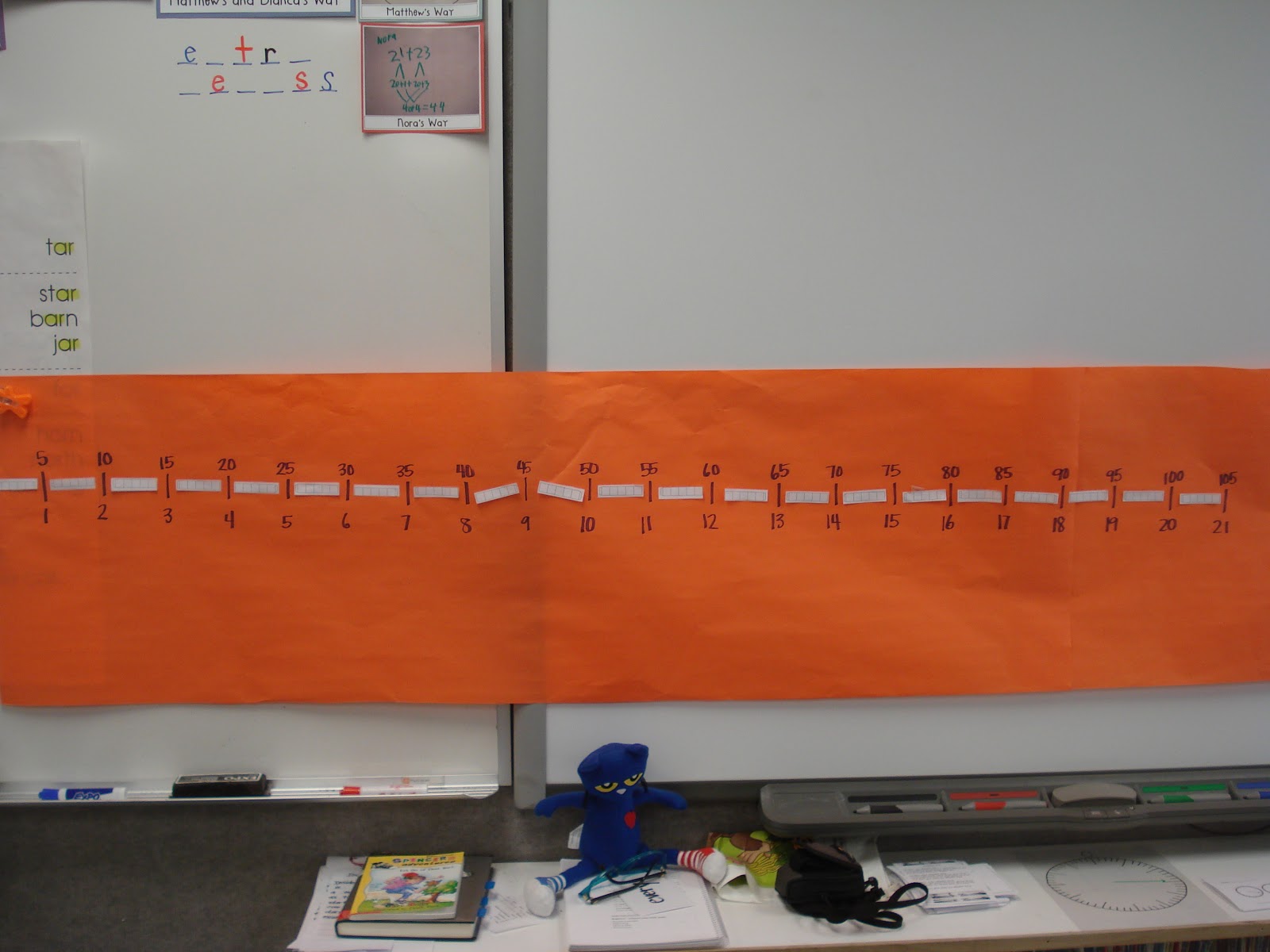
I'm teaching time in a new and adventurous way this year. This particular lesson all started with cubes. I would have never thought cubes could lead to a better understanding of time, but stick with me and you'll see that it makes complete sense. Each child had their own train of five.
Once we noticed several things about this interesting number line, we removed all the cubes past the 12th train and formed them into a circle like you see below.
Well, what do you know? Looks an awful lot like a clock, eh? Of course, there was much discussion going on throughout this lesson. I left out lots of information. I just wanted to give you a gist of how it went and wet your appetite. If you're interested in reading about the complete lesson, check out this post where you can find a link to an article that explains it in full. It's good stuff!
Wednesday, April 24, 2013
Slit Clocks?
I think after 19 years of teaching, I might be on the verge of possibly figuring out how to teach time. The short article below got me on the right track. It spells out four lessons in such a fabulously concrete and sequential manner. It makes a lot of sense. You should definitely read it. (Click on the picture for your own copy.)
Go grab that article. You'll be glad you did. I sure am!
I love how the article suggests introducing the clock with the hour hand only. It's a brilliant idea. Lesson two shows how to use slit clocks for this purpose, which I had never heard of before. Here are a few pictures of how to make one.
Draw the numbers of a clock on a paper plate. Then cut a slit at the 12.
Cut out a circle. Draw the hour hand like so and cut a slit as well.
Slide the small circle through the slit on the paper clock. Move the small circle from the back and hold the clock with the other hand.
In this lesson, the kids picked up very quickly that if the hour hand is pointing directly to a number, like the 6 for example, it's 6:00. When the hand is just beyond the 6, they learned to say, "a little past 6:00." If the hand is almost to the 6, they say, "a little before 6:00."
The kids had lots of opportunities to practice with partners, both showing times and reading times. They practiced directly on the hour, and they had a chance to be tricky as well by moving their hour hand a little before or after a number.
Go grab that article. You'll be glad you did. I sure am!
Subscribe to:
Posts (Atom)