Showing posts with label Kids 1st From Day One. Show all posts

Sunday, September 23, 2018

Glitch, Bummer, Disaster

Christine Hertz and Kristine Mraz are quickly becoming some of my favorite people. They are helping me beef up the social emotional ways I teach my kids. 

If you're unfamiliar with them, please please please read this post where I reference three things they've recently written that will likely transform your thinking and teaching.

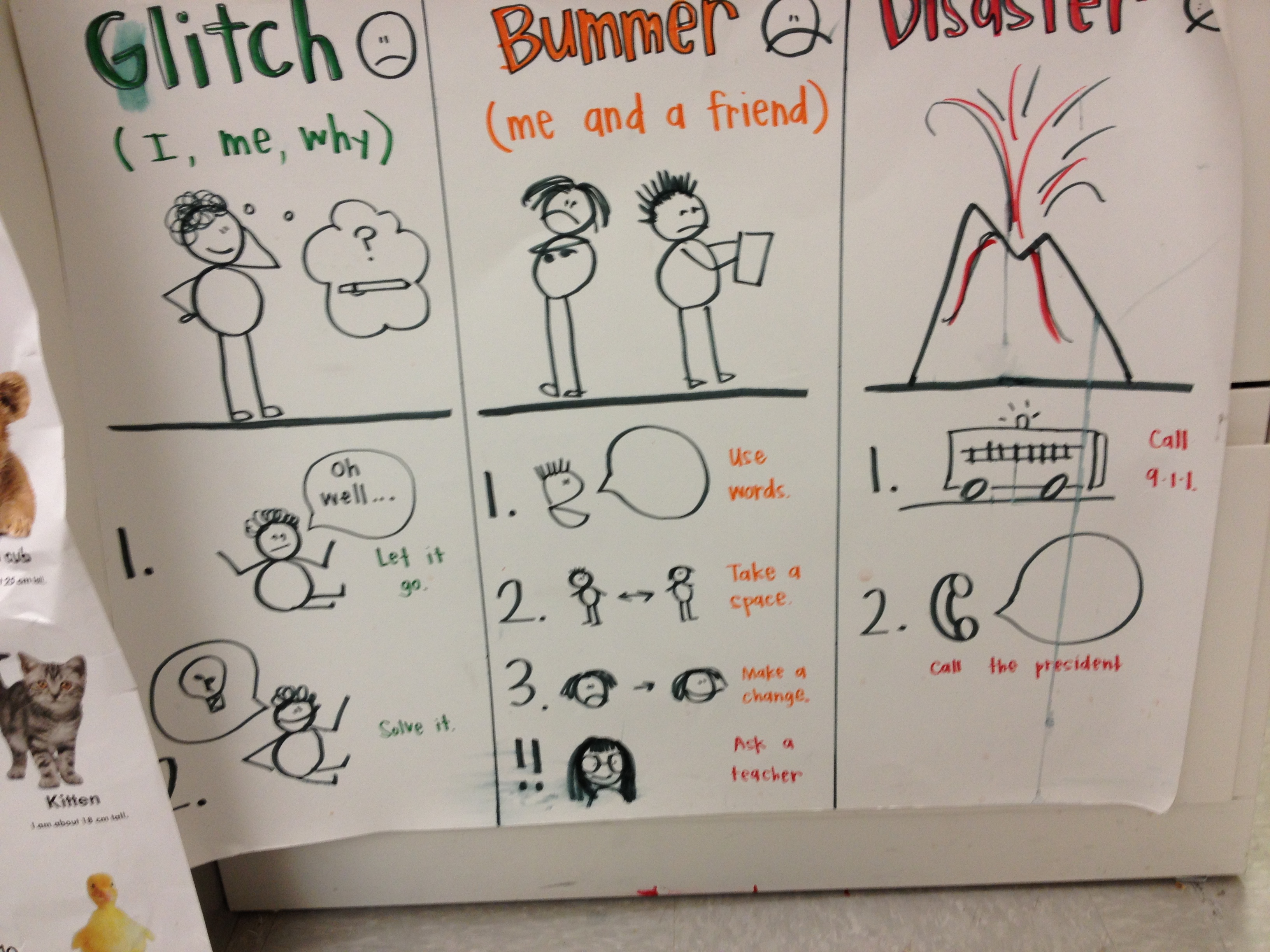
This coming week I'm going to tackle problem solving in my classroom. I'll be using the following two charts that Christine and Kristine use.


Aren't those some brilliant charts? I'm going to combine them into one chart and build it piece by piece until we've learned about each problem over a three-day period. (I actually wrote three lessons that will hopefully help me do this efficiently and effectively.)

I love the language that Christine uses once the chart is complete and kids are having problems.

  • It seems like you're really upset about that. I hear you.
  • What kind of problem do you think that is?
  • Do you have any ideas of how you might solve it?

Have I convinced you to go read what Christine and Kristine have to say? Do it now.


Pin It!

Saturday, September 22, 2018

Saturday Sayings: If He Could, He Would


"What's your mantra going to be?" That's what my secretary asked me the day I stood in the office and told my story - the one about a student's perplexing and frustrating behaviors. Haven't we all told that story a time or two? It's usually one that can't easily be resolved, but my secretary's question was the perfect response. She's heard my classroom mantra PD. She knows how strongly I believe in the power of words. And so began a quest for the words that would help me stay the course on behalf of this little person while hopefully preserving my own peace of mind. 

I turned to Kids 1st From Day One by Christine Hertz and Kristine Mraz who have been my guides on the side since day one of my school year. I'm in love with and challenged by the words they share from Katherine Reynolds Lewis. Can't behaving a certain way vs. not wanting to are two very different things. I can say from personal experience that the latter is an easy copout to embrace. 

Hertz and Mraz encourage teachers to believe that if a child could do something, he would. That mindset demands a different approach to challenges. Empathy and grace come to mind and maybe even a sliver of hope - hope that with the right scaffolds and supports, a child can be taught the skills necessary for social and emotional success, just like he can be taught to read or write. 

So my mantra? If he could, he would. 

I've been teaching long enough to know that five words aren't going to magically resolve any issues come Monday morning, but I know they have the power to change my mindset for the better. 

If he could, he would.


Pin It!

Sunday, September 2, 2018

Kristine and Christine

This post is a mishmash of resources that represent where my heart and head are right now in year 25 of my career. It's embarrassing and overwhelming to admit, but I've read some things in the last few months that have revealed some significant holes in my practice. Have I really been doing it all wrong all these years? Maybe I'm being slightly dramatic, but it's just confirmation that I must continually be a better version of myself. I'm confident the tools I'm about to share are going to help me get there.

Resource #1:
If you teach elementary children, read Kids 1st From Day OneDon't wait until your next break. Read it now. It is literally life-changing. I should probably reread certain sections of it before going to bed each night until the ideas become second nature. It's that good.


Resource #2:
Read this short post, Life After Clip Chartsby Kristine Mraz, co-author of the book you're going to read soon. I've never used clip charts, yet found this post to be another text that needs to be part of my nightly reading. She's challenged me to think about what I believe and to look closely at the practices that simply don't match up. Ouch.

Resource #3:
Read this post, Three Essential Social-Emotional Practices for the New School Year, by Christine Hertz, also co-author of your future favorite book ever. This post is meant to follow up Kristine Mraz's post, so do read them in order. It's enlightening, practical, and necessary and is already affecting my lesson plans for Tuesday.

Resource #4:
The first of Christine Hertz' three essential social-emotional practices is how to build awareness in our students of their social-emotional needs. The first step to building awareness is teaching children about their brains. She refers to Daniel Siegal's hand model. In Kids 1st From Day One, Kristine and Christine also talk about Siegal's analogy of the upstairs and downstairs brain. Both the hand model and brain analogy are concepts I want my students to know and understand sooner than later. So I've written two mini-lessons based on the resources mentioned. I want to offer them to you here. I'm not sharing because I think they're all that great. I haven't even taught them yet, and they're likely to need revision. I'm sharing because I think Kristine and Christine's work needs to influence more people. Period.

These two teachers and authors understand children in a way that inspires me. I'm humbled by their work and can only hope that my practice develops as a result of their influence. Please do take the time to seek out their wisdom. I think you will find their thoughts enlightening and worth your while.


Pin It!