Tuesday, May 1, 2012

The Proof's on the Wall

I love finding new ways of sending the message, "This space is as much yours as it is mine, and I want to cover these walls with proof."  

You're looking at an area of my classroom's library.  I bought garage sale and thrift store frames, painted them black, and turned this wall into a mini-gallery.  When the kids bring me artwork from home, I frame it here on the wall.  The only stipulation is that it must be original artwork.  It's not that I don't appreciate the coloring book pages.  (Those get stapled to the wall behind my desk.)  It just seems to me that if it's framed, I want it to be all them.


I'd eventually love to have more frames up.  Until then, when a new picture arrives, I just slip an older one out and add the new one.


I'm pretty sure this is an idea from The Sisters, so all credit goes directly to them.  I just tweaked it a little, which is what we all do to make the wonderful ideas of others fit our needs a little better.  It's all yours now if you'd like to tweak too.

Pin It!

Saturday, April 28, 2012

Saturday Sayings: The We-Do-Its

(Click on the above graphic to read previous Saturday Sayings.)

I've been looking forward to sharing this quote for a long time.  Hands down it's a favorite of mine.  I've even committed it to memory.  (Yeah, not impressive.  You'll see why.)


The way I feel about this quote is the way I feel about certain worship songs we sing at church.  Man, I wish I'd written that.  It's so simple and powerful all at the same time.  Regardless of its simplicity and power, it's not always the way we run the show though, huh?  

You do it.
or
I do it.  You do it.
or
I do it.  We do it.  You do it.

Anyone besides me guilty of abbreviating the process?  I suppose we get in a rush.  The time crunch is forever hanging over our heads.  Modeling and then sharing and sharing and sharing the learning process before completely handing it over takes time and planning as well.  If you're like me though, you can easily tell when all the we-do-its are accounted for. It's kind of obvious.  The kids understand, and the product we were hoping for meets our high expectations.  The equation works.  Thanks Regie for reminding us how much modeling and sharing the process make the difference in our teaching!


Have you been reading these other three Saturday Sayings?  If you haven't, you're seriously missing out.  I have been thoroughly blessed and inspired by these gals.  Do me a favor if you will.  Check them out today.  While you're there, let them know how they've inspired you too.  Thank you!


Conversations in Literacy
Sandi at Literacy Minute


Pin It!

Wednesday, April 25, 2012

Kids, Meet the Venn Diagram

I'm back with another way that I use the joys of stickiness in my classroom.  (Did you see my post about labels?  Go here if you're interested.)  Oddly enough, I find it useful to use labels when teaching about coins and Venn Diagrams.  I'll explain.  Below are two lovely assistants holding coins.


The rest of the class looks for details on both sides of the coins.  Volunteers say, "I notice that..." and I write down what they notice and stick it to the appropriate person.  If they notice something that both coins share, the label belongs on both kids.  (You can see three such labels in the picture.  They think that's the funniest thing.)


Once we've noticed the fronts and backs of both coins, I draw  a blank Venn Diagram on the chart, but I don't mention its name quite yet.  We then remove the labels from the kids and figure out where they would belong on the circles.  They especially love it when I remove the labels that the two kids share.  (I think the assistants donate a few hairs in the process.)  The kids figure out pretty quickly that the labels that were shared must fit in the middle.  Only after all the labels are removed do I give this whole circle business a name.  "Kids, meet the Venn Diagram."


Regie Routman says that "One demonstration is rarely enough," so we repeat this same procedure with other coin combinations.  It's great for coin identification, but it's also a very meaningful and sticky fun way of introducing the Venn Diagram.  I'm thinking there are other ways to teach a concept using assistants, labels, and the Venn Diagram.  Hmm?


Pin It!

Monday, April 23, 2012

The Joys of Stickiness

Give first graders some labels and permission to stick them on someone else, and their level of engagement is pretty sweet. I discovered this years ago, and it's become one of my favorite ways to practice all sorts of skills.

I use daily shared reading with big books to teach a lot of my phonics instruction.  I'm not much for random skills practice.  I'd much rather it come out of the literature we're enjoying.  On this particular day, I used words from our big book to teach the sounds of y at the end of a word.  After a quick secret sort and discussion about the sounds, I got out the labels. 


I put the above labels on the foreheads of two of my better readers.  (I choose these kids carefully.  Their job is important and not for those who don't already have a good understanding of the skill.)  Then they stood at the front of the room with these two sounds of y stuck to their heads, anxiously awaiting the next step.


All the other kids got a strip of blank labels like the one below.  (By the way, I cut the labels in half so they last me longer.)  Their job was to hunt for words in the room that ended in y.  After writing down a word, they took it to the correct person at the front of the room.


This next part is really important.  The person with the forehead label had to say, "What's the password?"  That was the clue to the child with the label to read the word they wrote.  (This is essential because otherwise it simply turns into a copying activity.  They must be reading.)  Then the person checked the word to see if it indeed belonged on them and that it was spelled correctly.  If so, the child with the label stuck it to the person's shirt, which they did with great joy.  Here are pictures of the two shirts at the end of the activity.
(I'm pretty bossy about where the labels belong and don't belong by the way.  They can easily end up in some inappropriate places.)
 

To sum up:  
It takes very little teacher prep and no copying of papers.  It comes right out of meaningful literature.  It doesn't take much time, so kids spend most of their time reading that meaningful literature.  It can be used with most any skill (compound words and contractions, /ow/ and /ou/, long a and short a, etc.)  The kids write.  The kids read.  The kids think.  The kids are engaged. The kids are motivated.  The kids love it!  Grab some labels and you're ready to go!

Pin It!

Saturday, April 21, 2012

Saturday Sayings: So Are the Ants

(Click on the above graphic to read other Saturday Sayings.)

Today's quote comes from The Daily Five.  It originated long before this book's time though.  Henry David Thoreau penned the words.
Selah.  I almost don't want to say anything and ruin the moment.  Let that soak in for a minute if you will. 


"I believe three things determine the successful development of literacy: time, time, time.  Stand in the doorway of your classroom and ask yourself this question: 'How are my students spending their time?'"
Richard Gentry, The Literacy Map 22


Classrooms are busy and buzzing with activity.  That's a given.  What are we busy about though?  How do our kids spend their time? It seems obvious that if we want them to be readers, they should be reading.  If we want them to be writers, they should be writing.  Sometimes it's hard to put ourselves in the position of the observer from the doorway, but if we did, what would we see?  

Remember, you're just getting started.  We'd love for you to visit three more Saturday Sayings.  Be ready for some inspiration.  I definitely am!


Pin It!

Thursday, April 19, 2012

Strong Voices Are Contagious

Teaching writing can be such a roller coaster at times.  One day it seems like they've got this poetry thing in the bag and then others...well, not so much.  At times I'm tempted to think, "Where am I going wrong?"  Sometimes it is my doing, but then I'm also reminded of this quote.

"Writing is a highly idiosyncratic process that varies from day to day.  Variance is the norm, not the exception."  
Carol Avery, And With a Light Touch 8

Today was one of those days when I concluded that they were indeed poets.  (Who knows what tomorrow may bring.) We were in need of a mini-lesson on the use of magical or poetic language instead of ordinary language.  I started off by reading a poem from one of our very own.  Sharing published poetry or my poetry is a common practice in my room, but there's something about sharing a first grader's poem that makes the writing of poetry more accessible.

(A Bat:  I'm black like the night sky like I'm invisible.)

Then I shared a published poem by Valerie Worth that contains excellent examples of magical language.
Click on the picture for a copy.

Next we revised a poem that we'd written a few lessons ago by adding more magical language.  It's nothing special you'll see, but shared writing is powerful regardless.

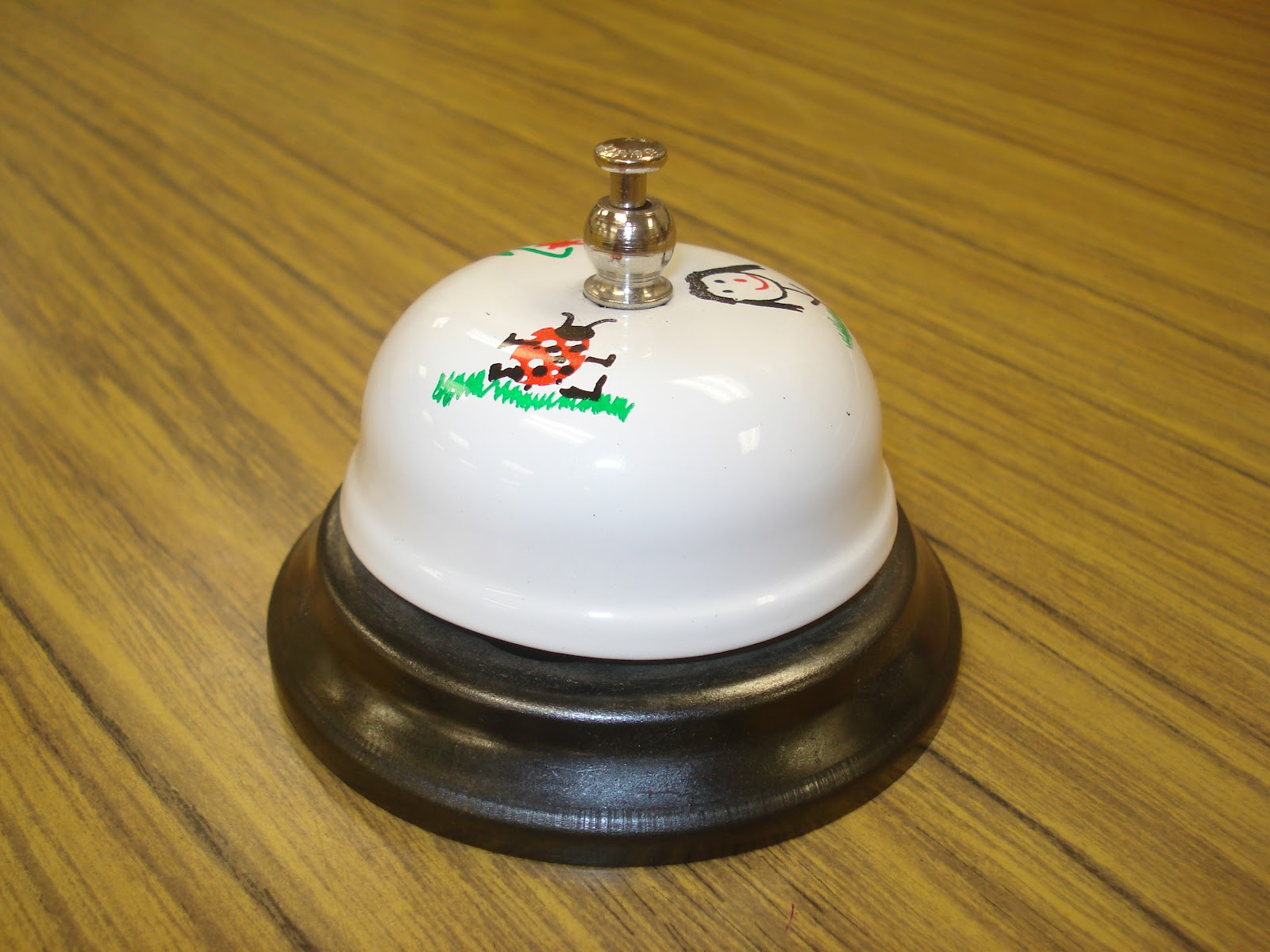
Finally I sent them off to find their own magical language.  I figured this wasn't going to be easy nor would 100% of them even think I was asking them to do something worthy of their time.  Thus, I found some help with this little dinger.  When I found someone writing a poem with magical language, they rang the bell and read their poem to everyone.  Needless to say, the classrooms across the hall were probably wondering about all the dinging sounds from our room.


"When children are sharing their work, the work that is going well serves as a stimulus for the others in the class.  Strong voices are contagious."  Donald Graves, Writing: Teachers and Children at Work 29

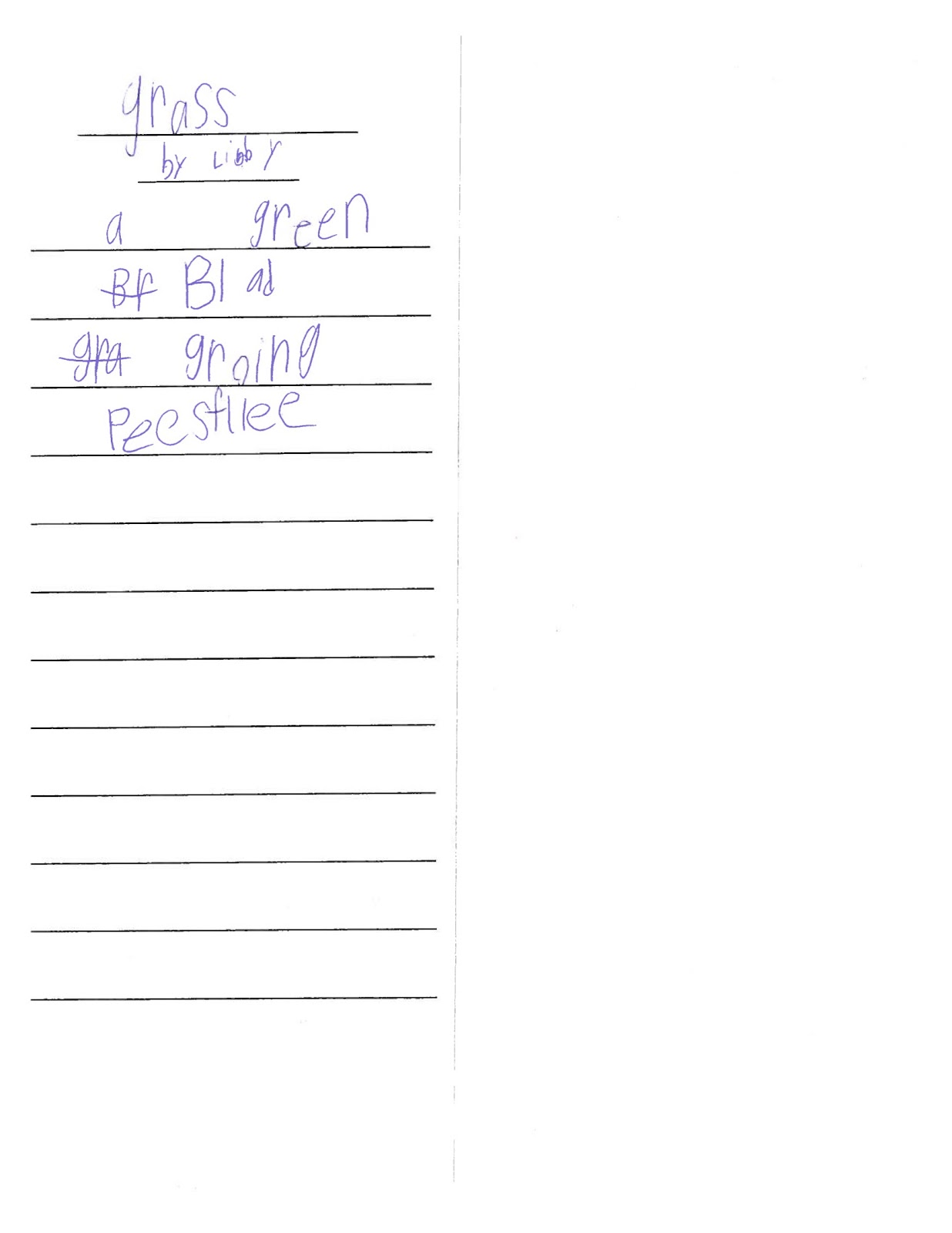
He is so right.  Sharing at the end of Writer's Workshop is  typical, but there's something contagious about sharing in the middle as well.  Here are some examples of the magic we were privileged enough to hear. (Some of these poems are from writers who struggle.  It's cool to see them shine too.)

(Grass:  A green blade growing peacefully.)
(Snowman:  A snowman sitting in the snow waiting and waiting for fun.)

(Moon: A round ball in the sky waiting for night to fall.)
(The Rain: Like rain dripping dropping peacefully in the puddle.)
(Sunflowers:  Sunflowers follow the sun as peacefully as they can.)
(Star:  A star shooting across the sky waiting for someone to make a wish.)

We have yet to arrive, but there are some good things going on with these little poets.  If you'd like to see how it all started and get your own copy of Lucy Calkin's poetry paper, click here.  (I hope no one is growing weary of my poetry posts!)


Pin It!

Wednesday, April 18, 2012

A Little Song About Names

My kids aren't often required to turn in papers, but when they do, there's always a possibility one or two or three could find their way to me without a name.  This little song helps remedy that problem.  It's also a useful management tool, because they know their names need to be written before we finish singing it.  I'm all about streamlining transitions!  (I apologize.  I don't know where I found this song.)


Here are the words just in case you didn't catch them all and would like to make this part of your classroom routine.  

(Click on the picture for your own copy.)
Happy singing!

Pin It!