Showing posts with label Reading Essentials. Show all posts

Saturday, November 3, 2012

Saturday Sayings: The Best in Us


What's on my mind these days?
I shall make a list.
(Warning:  It's ever so slightly opinionated.)

  • I'd like to thank the Common Core for letting me decide how to teach the standards.  (Regie would approve.)
  • Becoming familiar with the Common Core takes time and is a bit messy, but it's a given that I should know and understand what's expected of my learners.
  • I'm grateful for an administration that believes in my ability to design a Common Core curriculum that best fits the needs of my students, and I'm thankful they give me extra time to make that happen.
  • I can't count on a program, a series, or a teacher's manual to fill the gaps.
  • Developing curriculum is a lot of work, but it's better than being handed a product that I had no say in making and might not even believe in.  
  • Developing curriculum improves my understanding of the standards.
  • Developing curriculum requires me to know my students better. 
  • Developing curriculum gives me ownership of the teaching and learning in my classroom.
  • Developing curriculum makes me more reflective.
  • Developing curriculum makes me a better teacher. 
Making the Common Core my very own is not easy.  In fact, it's far from it and sometimes stretches me to my limits, but the process is worthy of my time.  When all is said and done, I believe it should bring out the best in us, not the worst.


Pin It!

Friday, June 29, 2012

Saturday Sayings: The Real World

(Click on the graphic for previous Saturday Sayings.)

Saturday has arrived early on my blog this week since I'm participating in a blog swap tomorrow.  Saturday Sayings are near and dear to my heart though, so I had to fit this in.

(I love this pic.)
That's what it says.  What does it mean?  To me it means that the learning that takes place at school, whether reading, writing, math, etc., should mirror the learning that takes place in real life.  As much as possible, they should be one and the same.  We could probably make a list of things we ask readers to do in the classroom that we would never expect them to do in real life.  How about this example?

"How many adult readers would choose to read if they had to take a multiple-choice test for every book they finished?"  Donalyn Miller, The Book Whisperer 131

(If you're interested in reading what one school is doing instead of computerized reading quizzes, a.k.a. AR, read Lori's post at Conversations in Literacy.  It's a good one!)

I'm just simply reminded that I need to keep a watchful eye on the kinds of things I ask of my readers, writers, and mathematicians.  I hope I can set up my classroom in a way that prepares them for lifetime thinking instead of only 12 years of school thinking.  Here's Regie's thought on the matter.

"Is this a practice that occurs in the real world?  If it's just a school thing, we need to question the practice."  Regie Routman, Teaching Essentials 39

I've got great news before you leave.  Tammy from First Grade at Storybook Cafe is joining me today for her own Saturday Sayings.  Ready to be inspired?  Head on over and enjoy her thoughts.  I'm on my way.


Pin It!

Saturday, March 10, 2012

Saturday Sayings: Don't Get Too Comfortable

Anyone new to my little world of blogging will quickly find out that I like educational quotes.  I've got one to share with you today that is high on my list of favorites.


I almost feel guilty saying this, but I have my share of dusty teacher's manuals in my room.  I'm just not a fan of programs.  I don't want to give off the impression that they're all evil.  I know they have some good to offer.  I'm sure they provide especially new teachers with a vision and plan, which are both very important.  I think Regie's basically saying though, "Don't get too comfortable."  A program is simply a resource that should be in a continual state of adaptation.


The closest thing to a program that I embrace in my room is Lucy Calkins' Units of Study for Primary Writing.  Do I teach it exactly like Lucy?  Nope, and I know that's just what she would expect of me in order to meet the needs of my students.  Modify, adapt, pick and choose, make it your own.


Regie also says, "...none of the exemplary teachers were tied to commercial materials.  Exemplary teachers taught children, and typical teachers taught programs." (185)


I understand this is only one person's opinion, but she inspires me to be exemplary.


Pin It!

Saturday, March 3, 2012

Saturday Sayings: Hook, Line, and Sinker

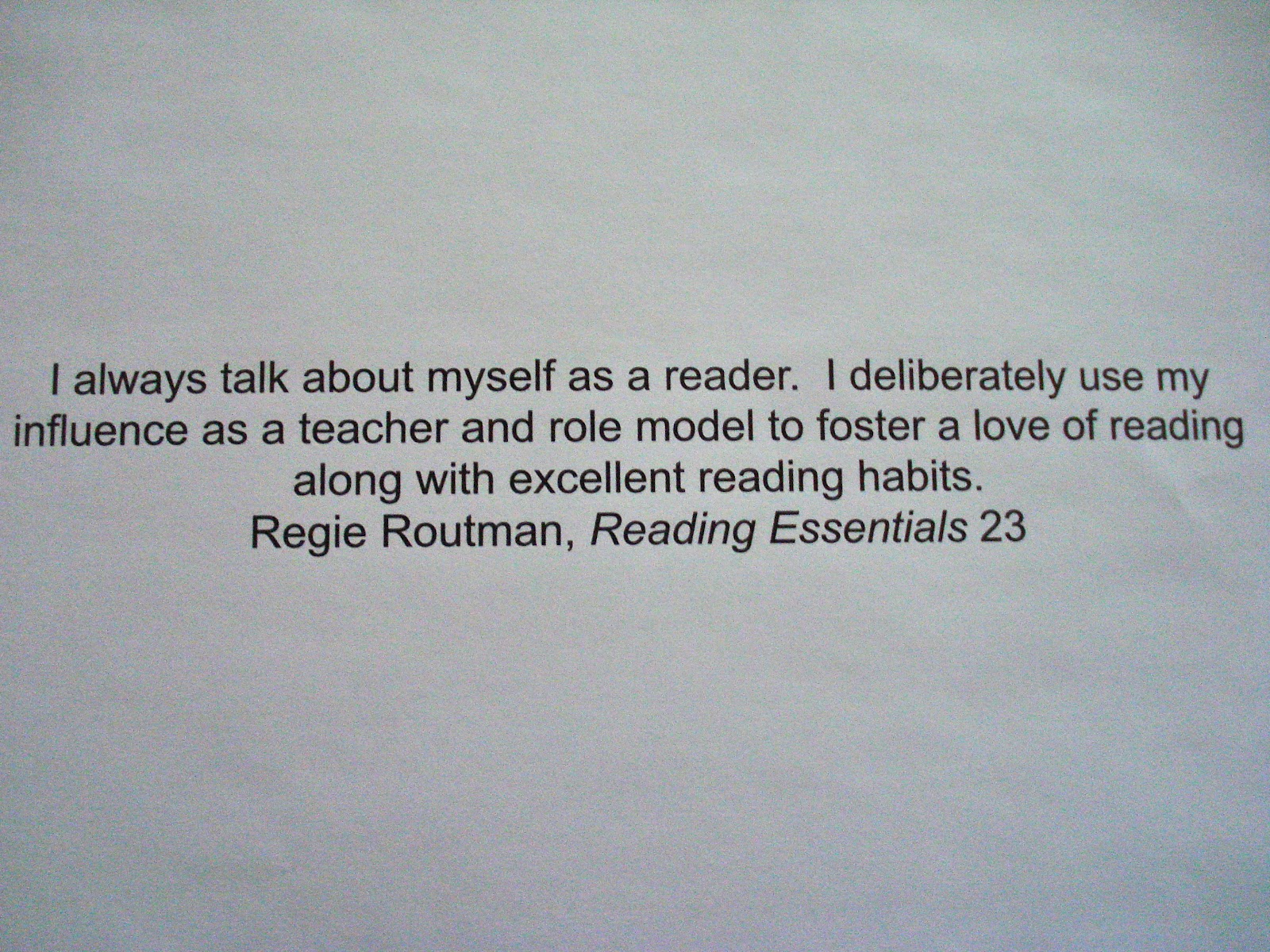
I'd love to share another one of my favorite quotes from one of my favorite literacy role models.  


I'm lucky enough to teach an age group that believes what I say hook, line, and sinker.  If you teach first grade you know what I'm talking about, right?  How many stories have I heard from parents over the years about a little argument their child had with them over how the parent was going about something?  First graders can be very adamant that their teacher does things the right way.  "Well, Miss McMorrow says..."  


The idea that my word is bible comes in really handy especially at the beginning of the year when I'm setting the scene for their lives as future readers.  I tell them over and over about my love for reading.  Pretty much every time I pull out a book I say, "Hey guys.  Have I ever told you how much I love to read?"  After the umpteenth time, their response is almost comical.  "Yeeeeees!" they say with a little roll of the eyes.  I love it!  


If you have a moment, please visit Lori at  Conversations in Literacy to see one of the ways her staff shares their reading lives with their school of readers.  It's pretty special!
Pin It!